MathJax

Showing posts with label brain. Show all posts

Monday, February 17, 2014

It's Go time.

It's no secret that I love chess. Now for the bad news: most chess games I play in-person do very little to help my brain. I'm sure this would quickly change if I signed up for some weekend tournaments, and this isn't always the case in my online play, but the truth is the lazy side of my brain is good enough to convincingly dismantle all but a few people I've met in non-chess-oriented settings.


So what are my options? I'd like to continue growing my ability to learn via games, but I'd like to get some more normal human interaction back into the mix. Playing a variety of German-style board games is one approach, but there is a (low) chance of developing metagaming heuristics effective enough to wind up in a similar situation with German board games as I currently have with chess.[1] It would limit my play to the friends I normally board game with and other board game nerds. Like I said, it's a low chance, but why not protect against this risk via portfolio diversification?

What I need is a game with a deep heuristics ladder that's also withstood centuries (if not millennia) of scrutiny. What drew me to chess was its lack of overt random elements[2], its freedom from politics as a 2-player game, and that it is a game of perfect information[3]. There's at least one other game that fits all of these criteria, plus I'm new to and therefore terrible at: Go.

I have no idea what's going on here, and I can't wait for that to change!
I'd like to commemorate my newfound enthusiasm for Go with a continued comparison against Chess. Since we've covered that both are are two-player turn-based strategy games of perfect information with deep heuristic ladders and no overt random elements that have withstood the test of time, let's go into some differences.

  • Chess has much more complex rules. There are six types of pieces, pawns move three different ways, certain material configurations are drawn by insufficient material, castling and its relationship to check and which pieces have moved is complex, and a large number of casual players don't know that en passant pawn captures exist.
  • In spite of simpler rules, Go has a much, much higher branching factor.[4] I see this partially as cheating by increasing the board size (19x19 vs. 8x8), but I'm over that.
  • The conceit of chess is much more amenable to suggesting state and directional heuristics to novice players: You want your King to live, a larger army will help capture the opponent's King, pieces have a sense of individuality and purpose both with and without the surrounding army. There's none of that in Go. The first few games of Go are a difficult process of discovery in transforming the basic set of rules and enormous branching factor into something that is within the limits of the human mind to evaluate.
  • Computers are terrible at Go. The anti-computer tactics employed by humans in Chess involve pushing games in the direction of favoring intuition over direct ply-by-ply calculation, which is Go's default setting.
  • Go is scored at the end. Chess is either a victory for one side or a draw.
  • Go's scoring mechanism and monotony of piece types allowed the creation of a simple handicap system to enable games between players of vastly different strength which are mutually useful intellectually. 
  • Philosophically, it's easy to imagine yourself as the King in a game of chess. If he's captured, you lose. It's a fight to the death, and you're right there in the middle. Go doesn't have that. You aren't any of the stones, and neither is your opponent. You play the role not of kings or battlefield commanders, but of emperor-gods hovering above a field of mortals.
  • If we insist on anthropomorphizing game pieces, Go may reflect a belief in the supremacy of groups over individual differences. Chess reflects the opposite.
  • While both games appreciate the role of forcing the opponent to respond (the Initiative in chess, Sente in go), chess's initiative is very all-or-nothing. You have it or you don't, and when you do then it's a mistake not to press it into something greater. Sente in go can be sort of "stacked," it seems, and much more difficult to put one's finger on. Whether a move in go forces an opponent to respond is harder to calculate directly, leading to more right-brained judgment calls. You see these sorts of judgment calls in chess as well (e.g. realizing an opponent's threat is a "ghost"), but it seems like a much more fundamental concept in go.
  • Similarly, developing one's pieces at the start of a chess game has a slightly different character than a ko threat in go. Areas of the board you judge as "dead" in go can still be useful as a ko threat later in the game, whereas lost material in chess will not rematerialize.
  • Go seems much more forgiving to beginners in the earlier stages of a game. Having so many more moves to choose from, there are more viable moves than you would see in chess. Many bad moves beginners make in chess have simple explanations for the nature of the error and a conclusive demonstration of why such moves are mistakes. Mistakes in any phase of a chess game can kill you. In go there is more equality between the viability of different moves absent Sente, and failing to immediately press Sente isn't a mistake the way fumbling the initiative is in intermediate+ chess games.
  • Threats in go are inaccessible before absorbing via literacy and drills several heuristics about living and dead structures and probably a few more things that I haven't learned yet, hence my poor go strength.
Come to think of it, the depth of go's heuristics ladder may be counterproductive to my interest in it. There are fewer go players than chess players that I have met in my life, so absorbing a handful of heuristics puts me at a great advantage much sooner. Wait a minute, that's what that handicap mechanism is for! This is going to be fun.


[1] This would most likely take the form of recognizing the essential games embedded in the rules of more recent board games and quickly discovering effective state and directional heuristics by combining effective strategies

[2] i.e. no dice, no cards. See Characteristics of Games.

[3] All information about the state of the game is known to both players; there's nothing like a private hand of cards.

[4] average number of options available to a player in a typical game state

Monday, December 16, 2013

Brain90X: Thoughts from "Characteristics of Games" and "Thinking, Fast and Slow"

There's a disturbing correlation between getting older and losing the ability to learn new things. Since learning new things is one of my favorite things in the whole wide world, I'd like to keep this ability as long as possible and increase this ability to its full potential. My plan? Games.

Here is my 3am rationale from last month, cleaned up slightly on a Saturday afternoon:

Learning new things takes a lot more energy than applying what's been learned. In a modern life, we're able to learn enough after a few decades to subsist mostly on applying what we have learned with a minimal amount of new learning required. Once we can pay our bills simply by applying learned knowledge, we aren't so motivated to go out and engage in the relatively mentally taxing enterprise of learning new things. My theory, then, is that the declining ability to learn new things with age is not a biological inevitability, but a function of atrophy once we've learned enough to pay our bills. What we need is a way to exercise the learning part of our brain so that it stays with us in perpetuity.

Climbing the heuristics ladder of a good game is the best kind of exercise you can give your brain. A "heuristics ladder" for a game is the set of increasingly complex set of rules-of-thumb you build up for yourself to let you know how well you're doing ("state heuristics") and what choices you make to maximize your chances of victory ("directional heuristics"). This type of mental activity is very different from memory recall and applying "street smarts."

Directional heuristics: Who's winning?
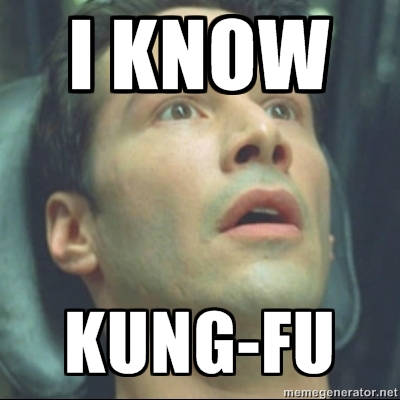
The first type of cheap, fast brain activity is memory recall: Erudition. The process of rote learning, while oft-scorned, is critical to competently functioning in a field. If your brain is a computer system, this is similar to "warming up your cache." (What is a cache?) I like to think of memory recall as "book knowledge." Literacy is the practice of transferring this type of information between humans (books, speech, this blog, plugs from The Matrix). (An interesting tangent is to note that body language and flirtatious subcommunication don't fit here at all. In fact, this information is background noise for the reality of most social interactions.)

Literacy of the future!
The second kind of cheap, fast brain activity is "street smarts": Worldliness. Street smarts assess both nouns and game strategies based on what has come before. Street smarts come from a statistical learning style where you observe classified and regressed examples in order to assess a new instance. In the computer world, this is how most kinds of machine learning work. Street smarts can be partially transferred through literacy as well--if it's done right and the source is trustworthy.

This leaves us with the most risky and expensive operations our brains perform: experimentation and creativity while climbing heuristics ladders: Cleverness. This is where the brain that comes up with new things to try out, where the brain sets up new literacy caches for information and aggregate data stores for examples. The more novel the situation, the more this part of the brain is engaged. It creates, tests, imagines, evaluates, and combines strategies. It working at its hardest when the answer is not available from recall or street smarts. Recall and street smarts are automatically and invisibly applied first in understanding a situation (thus introducing personal biases and new approaches). Heuristic ladder climbing is difficult, and our brains automatically take shortcuts to get to a passable approach.

This difficulty is a good thing for the brain. This is how the brain hits the gym to stay in shape. What an over-trained brain looks like is an exercise in imagination left to the reader.

Climbing heuristics ladders can itself be a function of literacy (chess books) and street smarts (what has worked for you and others in the past). There's also the punting strategy (try something. What happens?) and the combination strategy (adjust a strategy based on the assessed strengths and weaknesses of previous approaches). This engages Kahneman's "System 2" from Thinking, Fast and Slow. What's great about games is that this process happens when the stakes are low: you can face a variety of novel situations without having to bet your fortune, your business, or your life.

Now let's talk about logic's role here. Logic can transform novel situations into something we are better equipped to deal with: a rote answer or a way to proceed. It is also a System 2 function to multiply the abilities of System 1. Something about logical training is critical to our ability to climb heuristics ladders presented by games. It's a force-multiplier for erudition and honed instinct because it multiplies the situations where we can apply hard-won lessons.

Logic can take the lessons you learned from here...
...and suggest looking for opportunities such as this here.
Climbing heuristics ladders also sharpens creativity. Try something out. Give it your best shot. Compare it against what you know and how it works out. Build a logical system for thinking about the new situation. This is creativity. The germ of creativity can be something simple, but giving it an honest, competent try requires discipline. Plus as you gain experience, you realize that most ideas fail. The ones which succeed are precious. You develop a filter based on book smarts and street smarts to filter out the strategies you will even attempt! The more you know and can apply, the more narrowly you can/will filter the narrative of a creative experiment's success.

So as you get more worldly and erudite, you won't need to be as clever. Unfortunately, the clever part of the brain is a muscle. This is the learning center. This workout is what keeps your mind young and nimble. This is why we need games. Games of all sorts. Low cost of experimentation/success/failure. Creative heuristic ladder climbing/mental model building. Logical transformations to existing data stores. Creation of new data stores. Logically transforming and making analogies from games to other situations and novel situations to each other.

Playing games could keep this muscle in shape. It could be that the reason for declining mental strength is only partly chemical and very behavioral. Once you have enough book and street smarts to live and live comfortably, why continue engaging in this expensive mental exercise? Why sell past the close? Why work hard when you already have enough? To stay in shape.

Another exercise for the reader: How does this sort of narrative apply to the idea of upward mobility in a free economy?

I'd like to finally emphasize that this natural progression from the clever/creative to the worldly to the erudite is inevitable. Even in games with deep, rich heuristics ladders such as chess, a player with many years of experience can fall into winning on erudition and street smarts alone without realizing it. The key is to find competition at around the same level of erudition and worldliness so you force each other into the realm of the clever. Failing that, the game, as beautiful as it is, no longer keeps your brain in shape. It may still be enjoyable to play and very enjoyable to win, but in order to progress you'll need tougher opponents or new games.

Finally, an alternative to games, if none are available, is the deep study of various branches of mathematics. Try it out. There's much to learn, much to experiment with, and much to stir creativity.

Sources:
Footnotes:
  • A cache in computing is local storage of data that is expensive to retrieve; for example, it's faster to read from and write to RAM than to a traditional hard drive, so the contents of often-referenced files are loaded into RAM for fast manipulation. Similarly, microprocessors have a cache on the chip for data that are stored in RAM to speed up computations. When a cache is initialized, it is empty, but as the system is used the cache starts getting populated and the hoped-for speedup is realized. Using a system to populate the cache is sometimes called "warming it up."
  • Kahneman's "System 1" is the fast, cheap, automatic side of the brain. "System 2" is the slow, expensive, methodical part of the brain, sometimes an apologist for System 1, sometimes the only thing helping us see past the biases such automatic processing induces.